

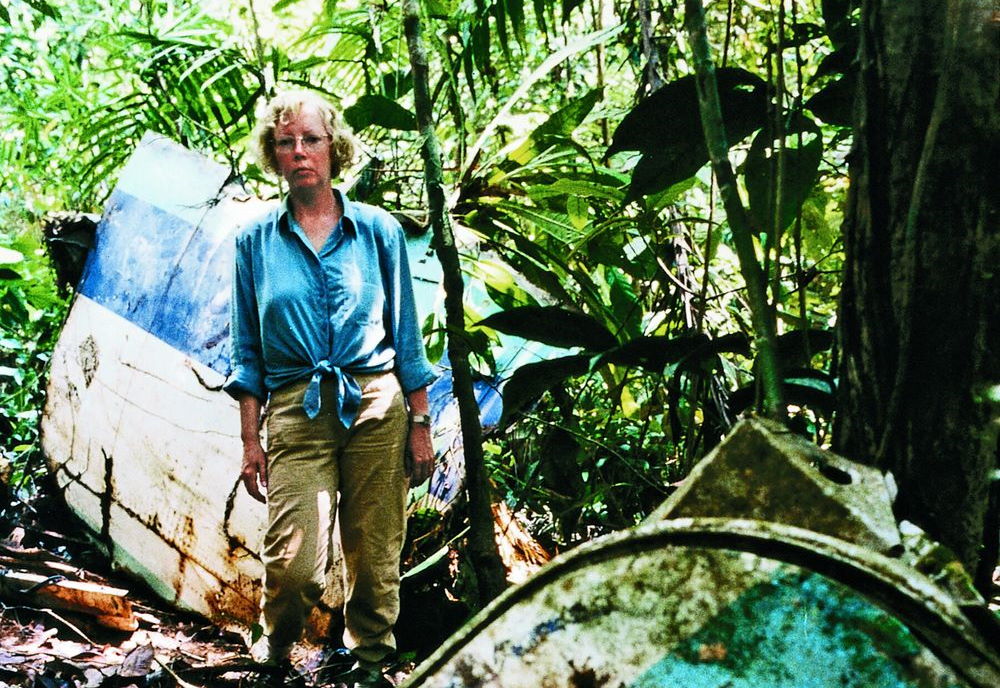
Juliane Koepcke fell two miles from the sky after her plane broke apart in a storm. She walked out of the Amazon jungle alive eleven days later.
This miracle happened on Christmas Eve in 1971. Juliane was just seventeen years old when the flight she was on with her mother disintegrated over Peru. She was strapped into her seat when she hit the thick trees below. She survived the fall because the seat slowed her descent, and then she walked through the wild jungle until she found help.
How did she survive the fall?
The plane was a Lockheed L-188 Electra. It flew into a massive thunderstorm over the rainforest. Lightning struck the engine, and the plane started to break apart mid-air. Juliane was still in her seat when it spun toward the ground.
Think about the odds of that. Most people do not survive a fall from such a height. She believes the rotation of the seat acted like a helicopter blade. It slowed her down enough so that she hit the canopy of the trees rather than the hard ground. It sounds like a movie, but it is a true human-interest story that defies all logic.
She woke up alone in the jungle. Her collarbone was broken, and she had a deep cut on her arm. Her mother was nowhere to be found. She spent her first day searching for her, but she was hurt and weak. That is when she knew she had to find a way out on her own.

How did she walk out of the jungle?
Juliane had learned some basic survival skills from her father, who was a biologist. She knew that in the jungle, water is your best friend. She found a small stream and decided to follow it downstream. She hoped it would lead to a bigger river and eventually to people.
The journey was brutal. She had no shoes, and her clothes were torn to shreds. She walked through mud and water that was filled with stingrays and caimans. She did not have food, so she ate nothing for over a week. She often talks about the inventor who failed a thousand times, and she uses that spirit to keep going when things get hard. She kept moving even when her body wanted to quit.
The insects were perhaps the worst part. Her arm had become infected, and maggots started to grow in her wound. She eventually remembered something her father told her about cleaning wounds with gasoline. She found a fuel tank from the plane, poured the gas on her arm, and pulled out dozens of maggots. It is a detail that shows how tough she really was at such a young age.
What happened when she found people?
On the eleventh day, she found a small boat tied to a tree. She was exhausted and could barely stand. She waited near the boat, hoping someone would return. Soon, three men who worked in the forest came back to their camp. They were shocked to see a girl who looked like she had come from the grave.
They gave her food and cleaned her wounds. Then, they took her by boat for seven hours to the nearest village. She was finally safe. She was the only person from the flight to make it out alive. It is a story of miraculous survival that people still study today to understand how the body reacts to extreme stress.
The search teams had been flying over the area, but the trees were too thick to see her. She had to save herself. She never gave up, even when she was completely alone in the dark, rainy woods.
Why do we still talk about this story?
The tale of Juliane Koepcke reminds us that humans have a hidden strength. When you are pushed to the very edge, you might find things inside you that you never knew you had. People often ask if she has nightmares about the crash. She says she does, but she also feels a deep sense of duty to live a good life because she was given a second chance.
She went on to become a biologist just like her parents. She returned to the jungle many times for her work. She did not let the crash stop her from loving the forest or from living her life to the fullest. She shows us that even after a fall from the sky, you can get back up.
It is easy to get lost in our daily problems. We worry about emails, traffic, or a bad day at work. But when you hear about someone like Juliane, it puts everything into perspective. She reminds me that as long as you are breathing, there is always a path forward. You just have to keep walking, one step at a time, until the trees finally clear.
What would you do if you were lost in the wild? Could you stay calm enough to find your way to safety?
